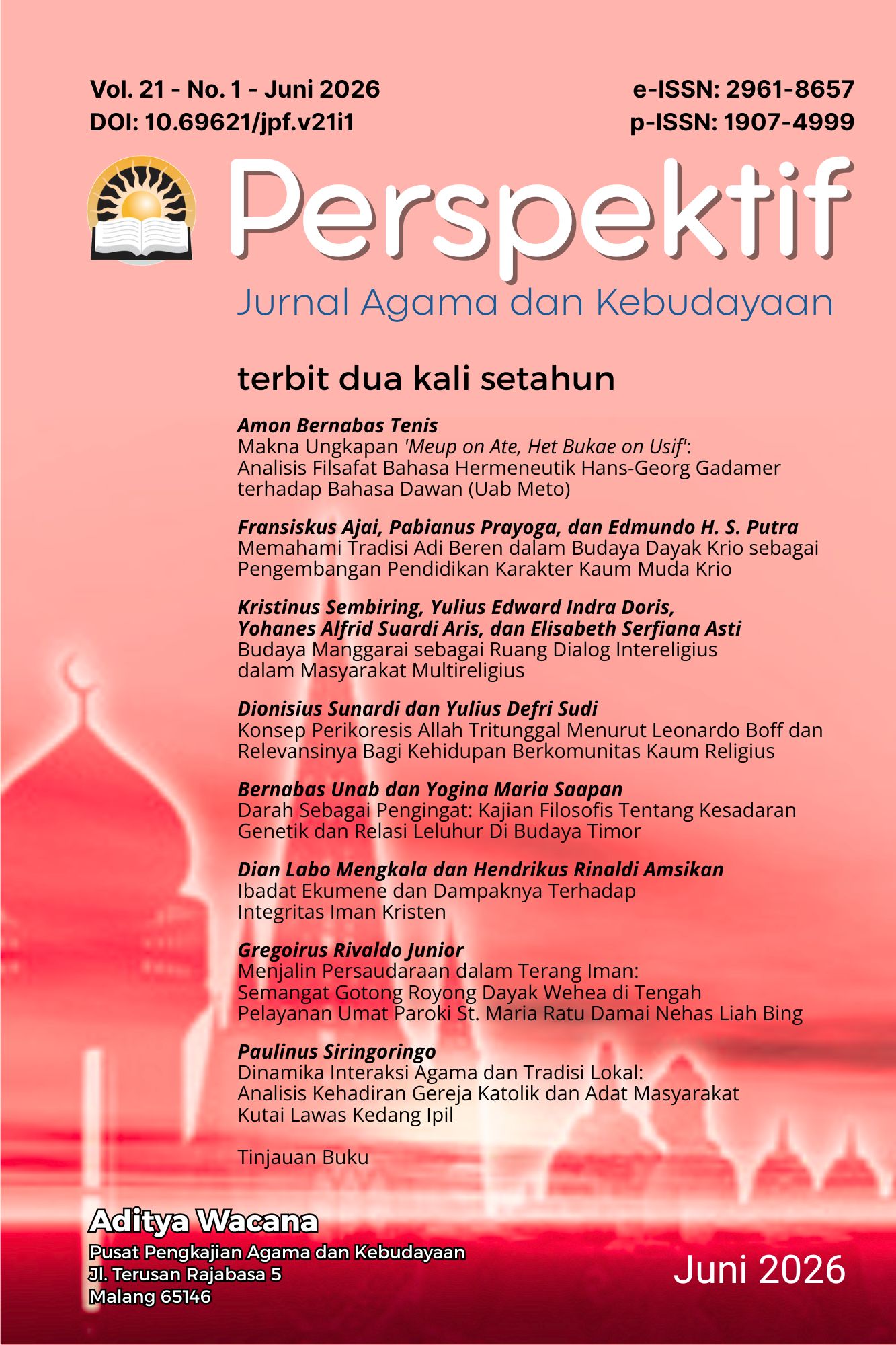
The Meaning of the Expression ‘Meup on Ate, Het Bukae on Usif’: An Analysis of Hans-Georg Gadamer’s Hermeneutic Philosophy of Language Applied to the Dawan Language (Uab Meto)
DOI:
https://doi.org/10.69621/jpf.v21i1.294Keywords:
Gadamerian Hermeneutics, Dawan Language, Traditional Expression, Work Ethic, Philosophy of LanguageAbstract
Language functions not only as a means of communication but also as a medium for transmitting values, worldviews, and collective wisdom within a community. One such example is the traditional Dawan expression “Meop on ate henati, bukae on usif,” which embodies values of work ethic, humility, and social honor. However, the philosophical meaning of this expression is often understood normatively and has rarely been examined through the lens of philosophical hermeneutics. This study addresses the problem of how the expression can be interpreted from Hans-Georg Gadamer’s hermeneutic perspective and what philosophical values it represents as an expression of the Dawan people’s way of life. This research aims to interpret the meaning of “Meop on ate henati, bukae on usif” and to reveal its philosophical and cultural significance. This study employs a qualitative approach using Gadamer’s philosophical hermeneutic method, involving textual analysis of the cultural expression, in-depth interviews with traditional leaders and native speakers, and observation of its socio-cultural usage. The findings indicate that the expression constitutes a living cultural text containing an ontological dimension of language, reflecting work ethic as a path to honor and prosperity, and functioning as a medium of moral education and intergenerational transmission of values within Dawan society.
Downloads
References
Bourdieu, P. (1986). Distinction: A Social Critique of the Judgement of Taste. Harvard University Press.
Damayanti, R. (2022). Bahasa dan identitas kolektif: Perspektif linguistik dan budaya. Jakarta: Pustaka Humaniora.
Damayanti, S. (2022). Peran Bahasa dalam Membangun Identitas Kolektif: Analisis Perspektif Kultural. Jurnal Linguistik dan Budaya, 34(2), 123-140.
Gadamer, H.-G. (2004). Truth and method (2nd rev. ed., J. Weinsheimer & D. G. Marshall, Trans.). New York: Continuum. (Original work published 1960)
Geertz, C. (1973). The interpretation of cultures: Selected essays. New York: Basic Books.
Halliday, M. A. K. (1978). Language as Social Semiotic: The Social Interpretation of Language and Meaning. Edward Arnold.
Hutabarat, D. (2020). Perbandingan Hermeneutik Gadamer dan Ricoeur dalam Menafsirkan Teks Tradisional. Jurnal Teori dan Praktik Sastra, 12(1), 45-61.
Hutabarat, L. (2020). Hermeneutika Gadamer dan Ricoeur dalam penafsiran teks tradisional. Jurnal Filsafat Nusantara, 18(2), 101-116.
Laksono, A. (2019). Bahasa Lokal sebagai Etos dalam Bahasa, Budaya, dan Identitas: Perspektif Hermeneutik Gadamer. Jurnal Linguistik, 15(3), 195-211.
Laksono, M. (2019). Bahasa lokal sebagai etos: Studi dalam Bahasa, Budaya, dan Identitas. Yogyakarta: Pilar Nusantara.
Widyaningsih, D. (2021). Bahasa Dawan dan mentalitas orang Timor: Sebuah pendekatan hermeneutik. Jurnal Kebudayaan Indonesia Timur, 5(1), 45-60.
Widyaningsih, P. (2021). Bahasa Dawan dan Mentalitas Orang Timor: Sebuah Pembacaan Hermeneutik. Jurnal Bahasa dan Sastra, 8(2), 56-71.
Widyantoro, A. (2020). Idiom lokal dalam perspektif etnografi komunikasi: Studi kasus pada masyarakat Timor. Lingua et Cultura, 12(3), 87-99.
Widyantoro, E. (2020). Analisis Idiom Lokal dalam Perspektif Etnografi Komunikasi. Jurnal Studi Bahasa, 18(4), 201-218.
Downloads
Published
License
Copyright (c) 2026 Amon Bernabas Tenis

This work is licensed under a Creative Commons Attribution-NonCommercial-NoDerivatives 4.0 International License.