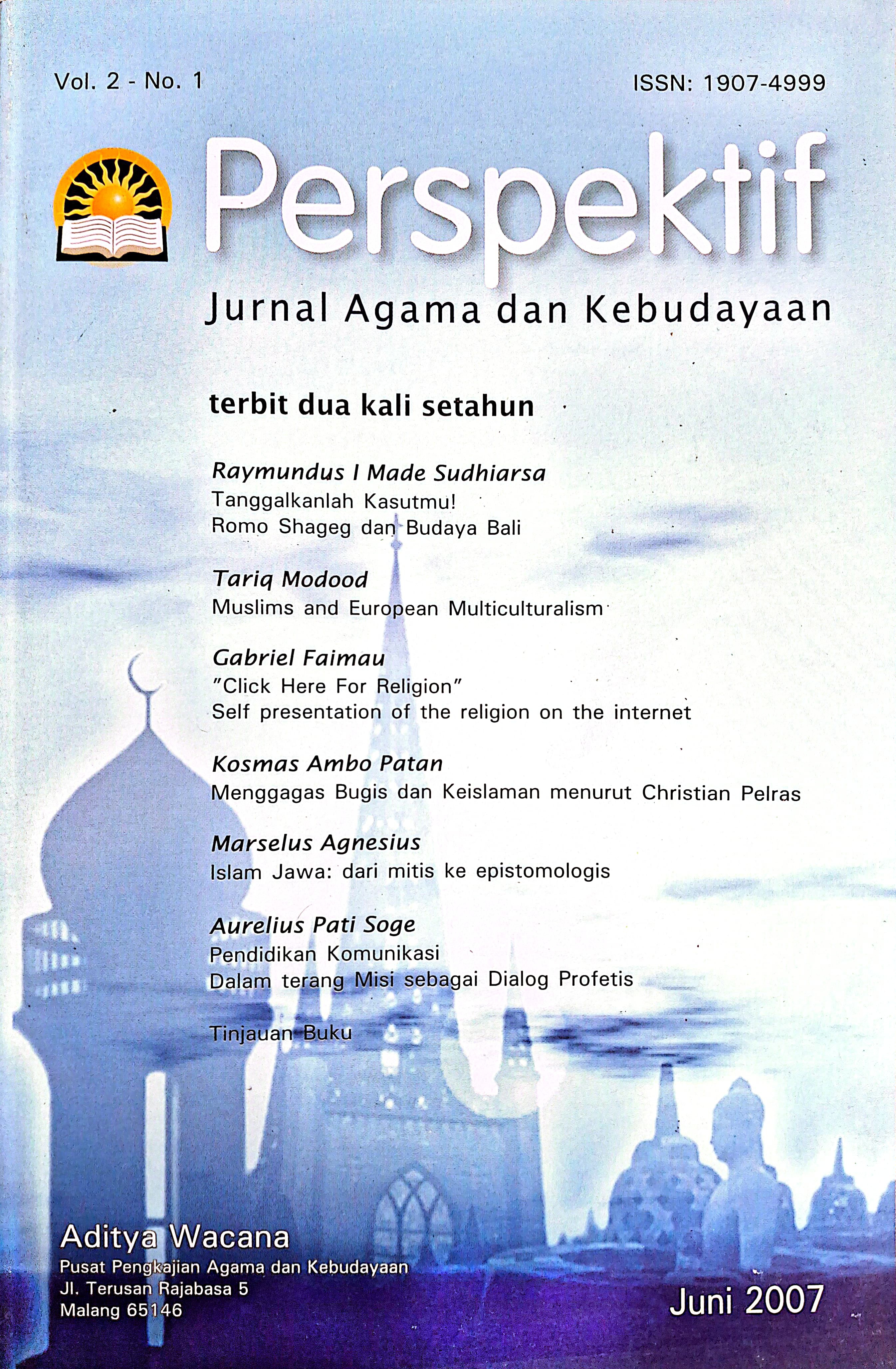
"Click Here For Religion"
Self presentation of the religion on the internet
DOI:
https://doi.org/10.69621/jpf.v2i1.256Palabras clave:
internet, religion, online religion, religion online, organized religion, religious affairs, religious participationResumen
Penggunaan Internet di era teknologi komputer membawa pengaruh besar dalam berbagai aspek interaksi manusia dan masyarakat, termasuk agama. Apakah Internet merupakan berkat atau kutukan bagi agama? Menyusul berkurangnya partisipasi orang dalam agama-agama formal karena serbuan Men sekularisasi, studi-studi sosiologis pernah memperkirakan kemungkinan digantikannya agama-agama institusional dengan bentuk-bentuk gerakan sosial-religius lain. Ada yang bahkan meramalkan kemungkinan hilangnya institusi agama-agama. Tulisan berikut coba menanggapi pikiran-pikiran itu dengan argumen bahwa dalam konteks luasnya penggunaan Internet, ide "tergantikannya" agama-agama dengan bentuk-bentuk baru ungkapan religius tidaklah tepat. Internet sebaliknya memberi ruang yang memungkinkan orang untuk memeroleh lebih banyak informasi seputar agama dan bahkan formasi hidup rohani di satu pihak dan di lain pihak, agama juga menemukan ruang untuk mengartikulasikan pesan-pesannya.
Descargas
Citas
Brasher, B. E. (2004). Give Me that Online Religion, London: Rudgers Uni- versity Press.
Bunt, G. R. (2004). "Rip. Burn. Pray.': Islamic Expression Online," in Dawson, Lorne L. and Cowan, D. E. (eds.), Religion Online: Finding Faith on the Internet, London: Routledge.
Campbell, H. (2004) "This is My Church': Seeing the Internet and Club Cul- ture as Spiritual Spaces," in Dawson, L. L. and Cowan, D. E. (eds.), Religion Online: Finding Faith on the Internet, London: Routledge.
Campbell, H. (2005) "Making Space for Religion in Internet Studies," in The Information Society, Vol. 21: 309-315.
Castells, M. (2001). The Internet Galaxy: Reflections on the Internet, Busi- ness, and Society, Oxford: Oxford University Press.
Cowan, D.E. (2002). "Online and in the Grove: Ritual and Embodiment in Neopagan E-Space," retrieved from http://c.faculty.umkc.edu/cowande, April 29, 2003.
Cowan, D. E. (2005). "Online U-Topia: Cyberspace and the Mythology of Placessness," in Journal for the Scientific Study of Religion, Vol. 44 (No. 3):257-263.
Dawson, L. L. and Cowan, D. E. (eds.) 2004, Religion Online: Finding Faith on the Internet, London: Routledge. nedod
Dawson, L. L. and Hennebry, J. (2004). "New Religions and the Internet: Recruiting in a New Public Space," in Dawson, L. L. and Cowan, D. E. (eds.), Religion Online: Finding Faith on the Internet, London: Routledge.
Foltz, F. and Foltz, F. (2003). "Religion on the Internet: Community and Virtual Existence," in Bulletin of Science, Technology & Society, Vol. 23 (No. 4):321-330.
Hadden, J.K. and Cowan, D.E. (2000). "The Promised Land or Electronic Chaos? Toward Understanding Religion on the Internet," in Hadden, J.K. and Cowan, D.E. (eds.), Religion on the Internet: Research Prospects and Promises, London: JAI Press/Elsevier Science.
Heelas, P. and Woodhead, L. (2005). The Spiritual Revolution: Why Reli- gion is Giving Way to Spirituality, Oxford: Blackwell Publishing.
Helland, C. (2000), "Online-Religion/Religion-online and Virtual Communitas," in Hadden, J.K. and Cowan, D.E. (eds.), Religion on the Internet: Re- search Prospects and Promises, London: JAI Press/Elsevier Science.
Helland, C. (2002). "Surfing for Salvation," in Religion, Vol. 32: 293-302.
Helland, C. (2004). "Popular Religion and the World Wide Web: A Match Made in (Cyber) Heaven," in Dawson, L.L. and Cowan, D.E. (eds.), Religion Online: Finding Faith on the Internet, London: Routledge.
Howard, R.G. (2000). "On-line Ethnography of Dispensationalist Discourse: Revealed versus Negotiated Truth," in Hadden, J.K. and Cowan, D.E. (eds.), Religion on the Internet: Research Prospects and Promises, London: JAI Press/Elsevier Science.
Horsfall, S. (2000). "How Religious Organizations Use the Internet: A Prelimi- nary Inquiry," in Hadden, J.K. and Cowan, D.E. (eds.), Religion on the Internet: Research Prospects and Promises, London: JAI Press/Elsevier Science.
Kort, A. (2005). "Dar al-Cyber Islam: Women, Domestic Violence, and the Islamic Reformation on the World Wide Web," in Journal of Minority Muslim Affairs, Vol. 25 (No. 3):363-383.
Larsen, E. (2004). "Cyberfaith: How Americans Pursue Religion Online," in Dawson, L.L. and Cowan, D.E. (eds.), Religion Online: Finding Faith on the Internet, London: Routledge.
Luckmann, T. (1967). The Invisible Religion: The Problem of Religion in Modern Society, London: Macmillan Ltd.
Lyon, D. (2000). Jesus in Disneyland: Religion in Postmodern Times, Cam- bridge: Polity Press.
Ong, W.J. (1988). Orality and Literacy: the Technologizing of the Word, London: Routledge.
Ramo, J.C. (1996). "Finding God on the Web," in TIME 149 (1): 52-58.
Taylor, J. (2003). "Cyber-Buddhism and Changing Urban Space in Thailand," in Space and Culture, Vol. 6 (No. 3):292-308.
Young, G. (2004). "Reading and Praying Online: The Continuity of Religion Online and Online Religion on Internet Christianity," in Dawson, L.L. and Cowan, D.E. (eds.), Religion Online: Finding Faith on the Internet, London: Routledge.
Zaleski, J. (1997). The Soul of Cyberspace: How New Technology is Chang- ing Our Spiritual Lives, New York: Harper Collins.
Descargas
Publicado
Cómo citar
Licencia
Derechos de autor 2007 Gaby

Esta obra está bajo una licencia internacional Creative Commons Atribución-NoComercial-SinDerivadas 4.0.