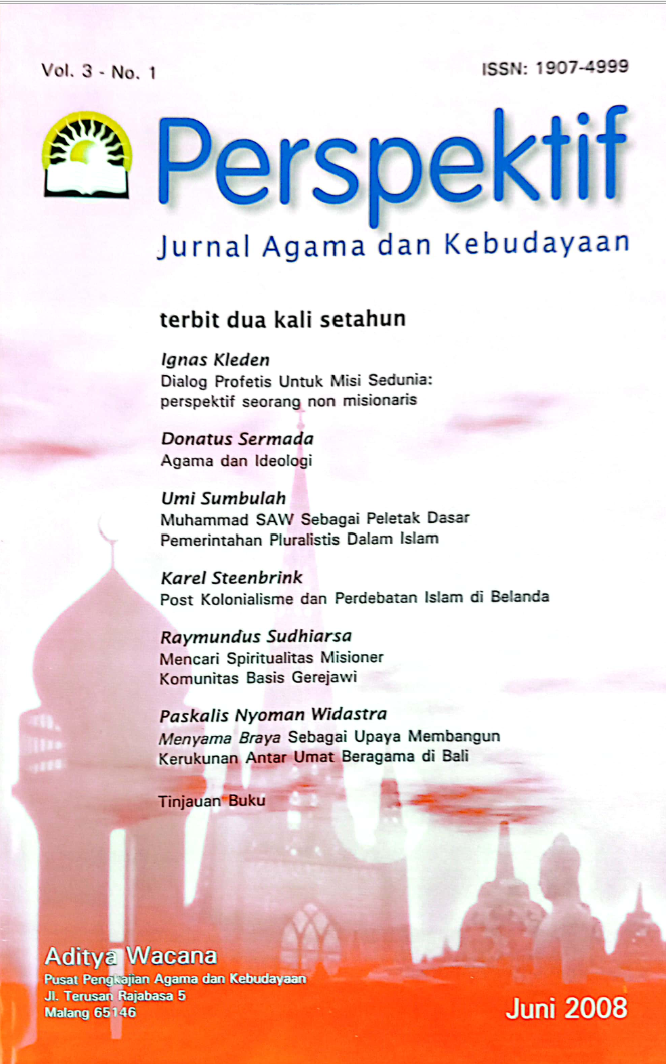
Muhammad SAW Sebagai Peletak Dasar Pemerintahan Pluralistis Dalam Islam
DOI:
https://doi.org/10.69621/jpf.v3i1.370Keywords:
Konstitusi Madinah, prinsip universal, pemerintahan pluralistisAbstract
Socio-historical setting of Madinah, which was more opened and more cosmo- politan compared to Mecca, was the basic capital for the success of Muhammad in building pluralistic governmental base. The emergence of Madinah consti- tution which involved all Madinah's elements (Muslim and non-Muslim groups) was taken as the tenet of building well-established socio-political system ensuring the equality for all. Considering the admittance of equality, all ele- ments of Madinah held commitment and loyalty toward the prophet leadership. Therefore, they built and created great civilization.
Downloads
References
Abd al- Raziq, Ali (2002). Islam dan Dasar-dasar Pemerintahan : Kajian Khilafah dan Pemerintahan dalam Islam (terj. M. Zaid Su'di), Yogyakarta: Jendela.
Armstrong, Karen (2002). Muhammad Sang Nabi: Sebuah Biografi Kritis (terj. Sirikit Syah), Surabaya: Risalah Gusti.
Brockelmann, Carl (1974). History of the Islamic Peoples (trans. Joel Carmichael and Moshe Perlmann), London: Routledge & Kegan Paul.
Bulac, Ali (2001). "Piagam Madinah" dalam Kurzmann, Charles (ed.). Wacana Islam Liberal: Pemikiran Islam Kontemporer tentang Isu-isu Global. Jakarta: Paramadina.
Gruenebaum, G.E.von (1970), Classical Islam: History 600 A.D.-1258 A.D. (trans. Katherine Watson), Chicago: Aldine Publishing Company.
Guillaume, Alfred (1975). Islam. USA: Penguin Books.
Hitti, Philip K. (1970). History of the Arabs. London: The Macmillan Press Ltd.
Hodgson, Marshall G.S. (1974). The Venture of Islam: Conscience and His- tory in a World Civilization. Chicago: The University of Chicago. Muzaffari, Mehdi (1997). Kekuasaan dalam Islam. Terj. Abdurrahman Ahmed. Jakarta: Pustaka Panjimas.
Pulungan, J. Suyuthi (1996). Prinsip-prinsip Pemerintahan dalam Piagam Madinah Ditinjau dari Pandangan al-Qur'an. Jakarta: RajaGrafindoLSIK.
Shaban, MA. Sejarah Islam: Penafsiran Baru 600-750. Jakarta: Rajawali Pers.
Shiddiqi, Nourouzzaman (1996). Jeram-Jeram Peradaban Muslim. Yogyakarta: Pustaka Pelajar.
Syalabi, Ahmad (2003). Sejarah dan Kebudayaan Islam 1 (terj. Mukhtar Yahya), Jakarta: Pustaka Al-Husna Baru, cet. VI.
Watt, Montgomerry (1974). The Majesty That Was Islam. London: Great Britan.
Watt, Montgomerry (1984). Muhammad Nabi dan Negarawan (terj. Djohan Efendi), Jakarta: Kuning Mas.
Downloads
Published
License
Copyright (c) 2008 Umi Sumbulah

This work is licensed under a Creative Commons Attribution-NonCommercial-NoDerivatives 4.0 International License.